Polytetrafluorethylene (PTFE), because of its strong chemical resistance and excellent sealing ability, is widely used in different industries. From chemical processing, pharmaceuticals, water treatment, to industrial piping and food processing units, PTFE and PTFE-seated ball valves are used on a daily basis.
But like any valve type, PTFE ball valves are not perfect for every application. Their performance depends on factors like temperature, pressure, media type, and operating frequency. This blog covers what PTFE ball valves are, where they work best, and most importantly, their key advantages and disadvantages so you can choose the right valve with confidence.
What Is a PTFE Ball Valve?
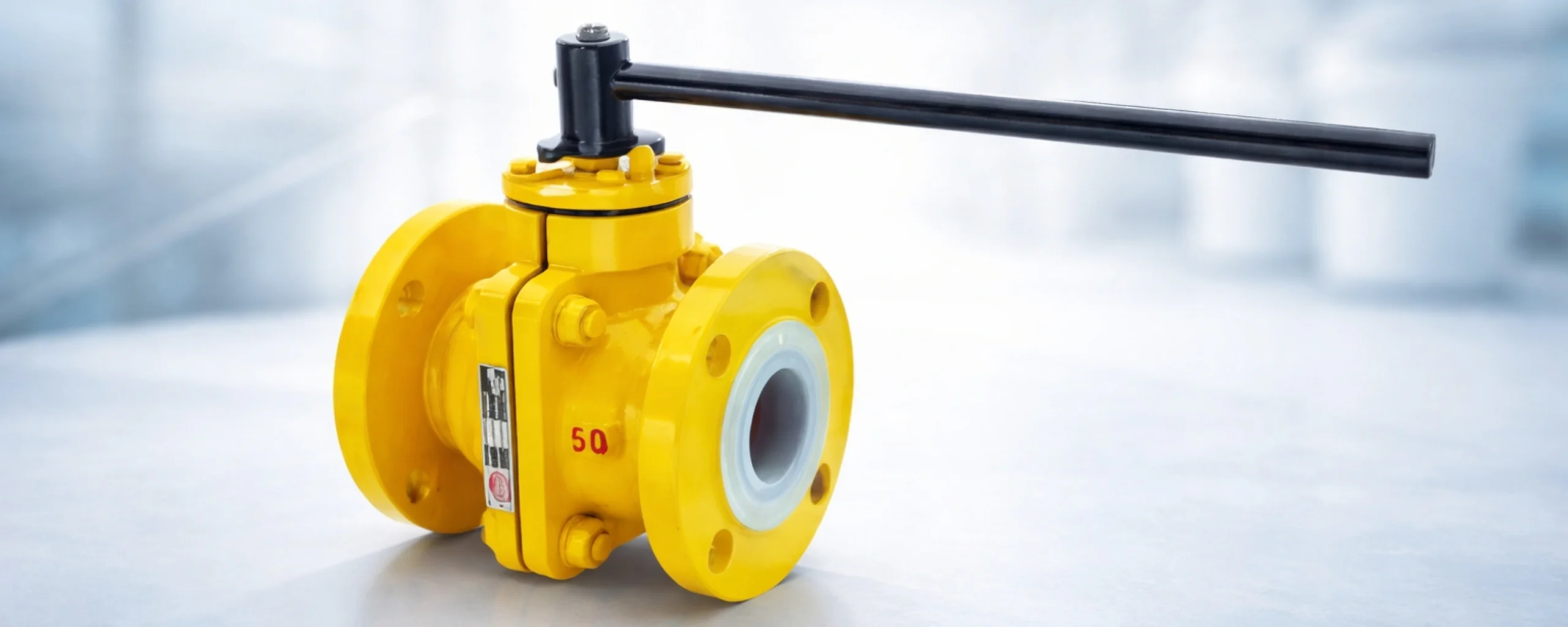
A ball valve is a quarter-turn valve that uses a rotating ball with a bore (hole) to control flow. When the bore aligns with the pipeline, the valve is open; when rotated 90 degrees, it closes.
In a
PTFE ball valve, PTFE (Polytetrafluoroethylene) is used in critical internal components, most commonly the
seats,
seals, and sometimes as a
lining to protect the body from aggressive chemicals. PTFE is well-known for its non-reactive nature, low friction, and excellent chemical compatibility.
Common PTFE ball valve configurations:
- PTFE-seated ball valve: PTFE is used for seats and sealing elements
- PTFE-lined ball valve: PTFE lining protects the valve body from corrosive media
- Full-bore vs reduced-bore: depends on flow requirement and pressure drop sensitivity
- Manual, pneumatic, or electric actuated: depends on automation needs
Where PTFE Ball Valves Are Commonly Used
PTFE ball valves are preferred in applications where corrosion resistance and leak-tight sealing matter most, such as:
- Chemical plants
- Pharmaceuticals and biotech
- Water treatment
- Food & beverage
- Pulp & paper
- Laboratories and specialty process lines
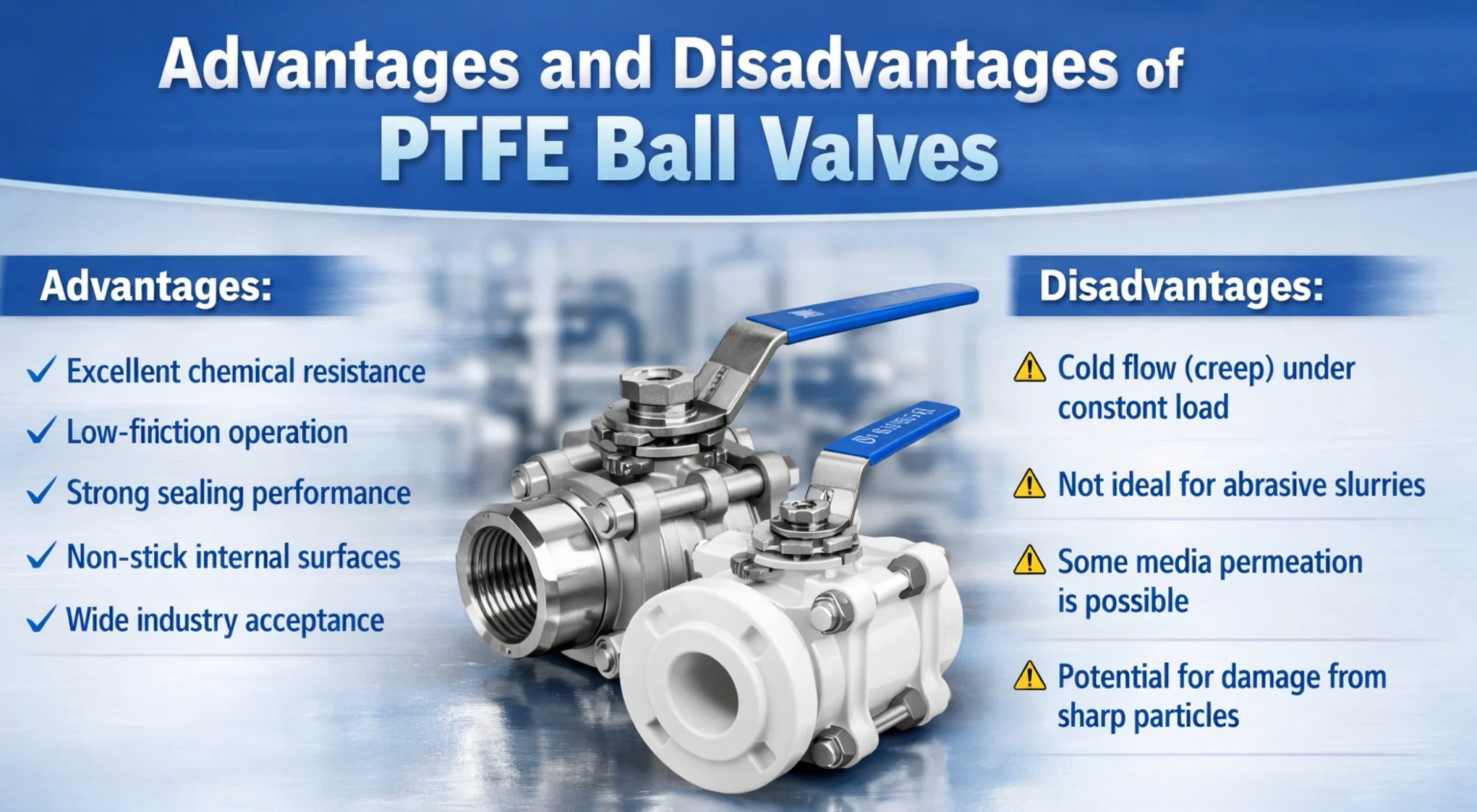
Advantages of PTFE Ball Valves
PTFE brings unique performance benefits to ball valves, especially when handling aggressive fluids or where smooth operation is required.
| Advantage |
Why It Matters |
Typical Benefit/Result |
| Excellent chemical resistance |
PTFE is highly inert to many chemicals |
Ideal for acids, alkalis, and solvents |
| Low-friction operation |
PTFE has a naturally low coefficient of friction |
Smooth quarter-turn, lower torque |
| Strong sealing performance |
PTFE seats conform well to the ball |
Reduced leakage, tighter shut-off |
| Non-stick internal surfaces |
PTFE resists sticking and buildup |
Better flow, less clogging in many fluids |
| Corrosion protection (in lined valves) |
PTFE lining shields the metal body |
Longer valve life in corrosive services |
| Wide industry acceptance |
Commonly used across process industries |
Easy availability, familiar performance |
| Good for frequent open/close cycles |
Ball valves are quick and reliable |
Fast operation with minimal flow restriction |
| Lower maintenance in clean media |
Fewer moving parts than many valve types |
Reduced routine maintenance needs |
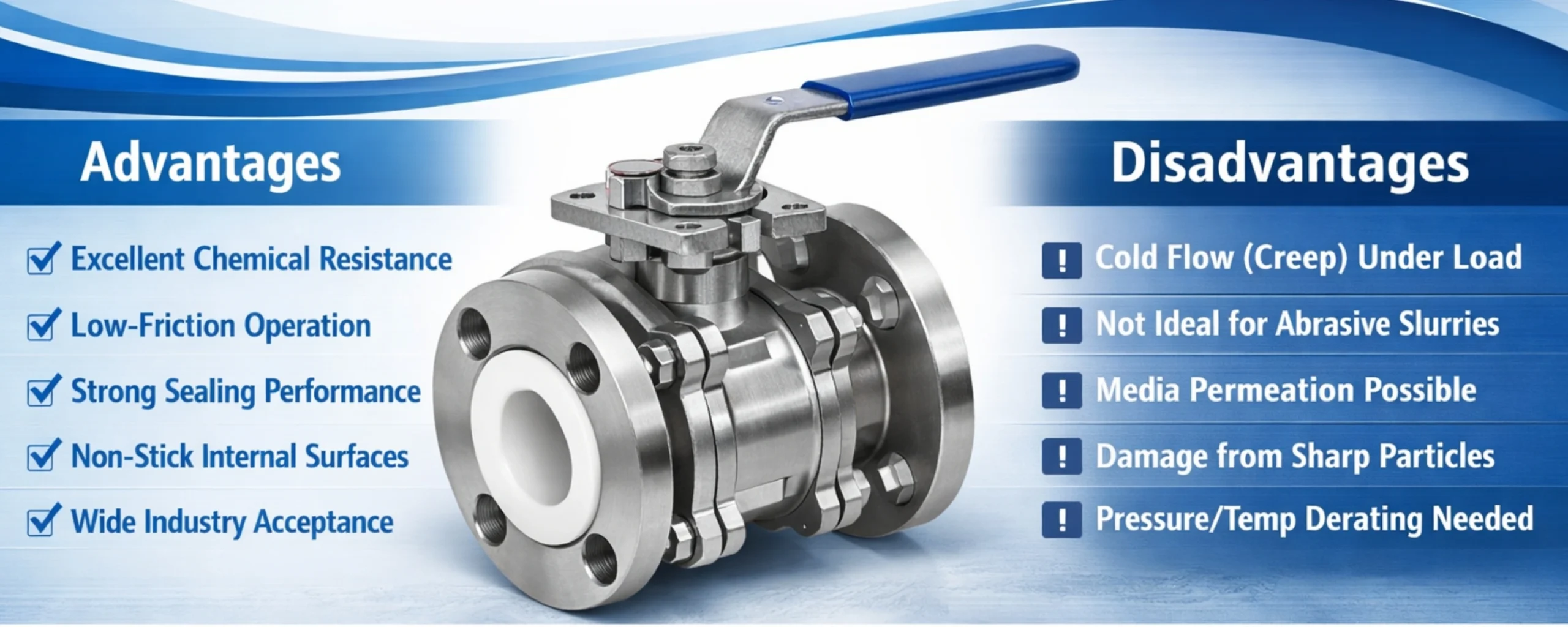
Disadvantages of PTFE Ball Valves
Despite their strengths, PTFE ball valves have limitations—especially around temperature, pressure, and certain mechanical stresses. Understanding these downsides prevents premature failure and costly downtime.
| Disadvantage |
What It Means in Real Use |
Risk/Impact |
| Limited high-temperature capability vs metal seats |
PTFE softens and creeps at elevated temperatures |
Seat deformation, reduced sealing over time |
| Cold flow (creep) under constant load |
PTFE can slowly deform under pressure |
Loss of preload, potential leakage in the long term |
| Not ideal for abrasive slurries |
PTFE is softer than many engineering plastics/metal |
Seat wear, scratches, shorter service life |
| Pressure/temperature derating required |
PTFE valves must be sized for actual conditions |
Wrong selection can cause failure or leakage |
| Potential for damage from sharp particles |
Hard debris can scratch the ball/seat interface |
Leaking shut-off, frequent seat replacement |
| Some media permeation is possible |
Certain gases/chemicals can permeate polymers |
Sealing challenges in specific services |
| Fire safety limitations (standard PTFE designs) |
PTFE can degrade under fire exposure |
Not suitable unless fire-safe certified design |
| Torque can increase as the seats wear or deform |
Operating force may rise with time |
Actuator sizing issues, harder manual operation |
Key Performance Factors That Decide Suitability
Choosing a PTFE ball valve isn’t just about “chemical resistance.” Consider these practical factors:
1) Temperature Range
PTFE typically performs well in moderate process temperatures, but at higher temperatures, it can lose mechanical strength and begin creeping under load. If your process runs hot (or cycles hot/cold), confirm:
- Valve’s temperature rating at operating pressure
- Whether the design includes spring-loaded seats or live-loading to maintain the sealing force
2) Pressure Rating and Derating
PTFE-seated valves often require
pressure derating as temperature rises. A valve rated for high pressure at room temperature may not hold the same rating at elevated temperatures. Always check the manufacturer’s pressure-temperature chart.
3) Media Type: Chemical v/s Abrasive
- Great for chemicals: acids, alkalis, solvents (depending on compatibility)
- Not great for abrasives: sand, slurry, crystallizing fluids, scale-forming mediaIf you have abrasive media, you may need harder seats (like reinforced PTFE, PEEK, or metal seats) or a different valve type altogether.
4) Frequency of Operation
Ball valves are excellent for quick on/off control. However, for throttling (partially open) with high velocity or abrasive media, the seat can wear faster.
Learn more about the key benefits of Teflon (PTFE) bushes for industrial applications here:
5 Key Benefits of Teflon Bushes for Industrial Applications.
How to Choose the Right PTFE Ball Valve
Before you buy or specify a PTFE ball valve, confirm:
- Media compatibility: chemical type and concentration
- Operating temperature: continuous and peak temperatures
- Operating pressure: normal and surge pressure
- Solids/abrasives present: yes/no and particle size
- Valve size and bore type: full bore if you need minimum pressure drop
- End connections: flanged, threaded, socket weld, tri-clamp
- Automation needs: manual vs pneumatic/electric actuation
- Certification needs: fire-safe, anti-static, food-grade compliance (if relevant)
Conclusion
To conclude, it is best to state that PTFE ball valves are a smart choice for many industrial and process applications, especially where
chemical resistance,
smooth operation, and
tight shutoff are required.
Their advantages make them extremely popular across India’s chemical, pharmaceutical, and water treatment sectors. However, they do have limitations: PTFE can creep under load, has temperature/pressure constraints compared to metal seats, and may wear faster in abrasive or dirty media.
The best results come from selecting the right PTFE valve design for your exact operating conditions and following basic protection practices like filtration and correct use.
How do I choose the right PTFE ball valve?
Consider these factors:
- Media compatibility (chemical type & concentration)
- Operating temperature and pressure (including peaks)
- Presence of solids or abrasive particles
- Valve size and bore type (full or reduced)
- Required actuation (manual, pneumatic, electric)
- Certification needs (fire-safe, anti-static, food-grade)