
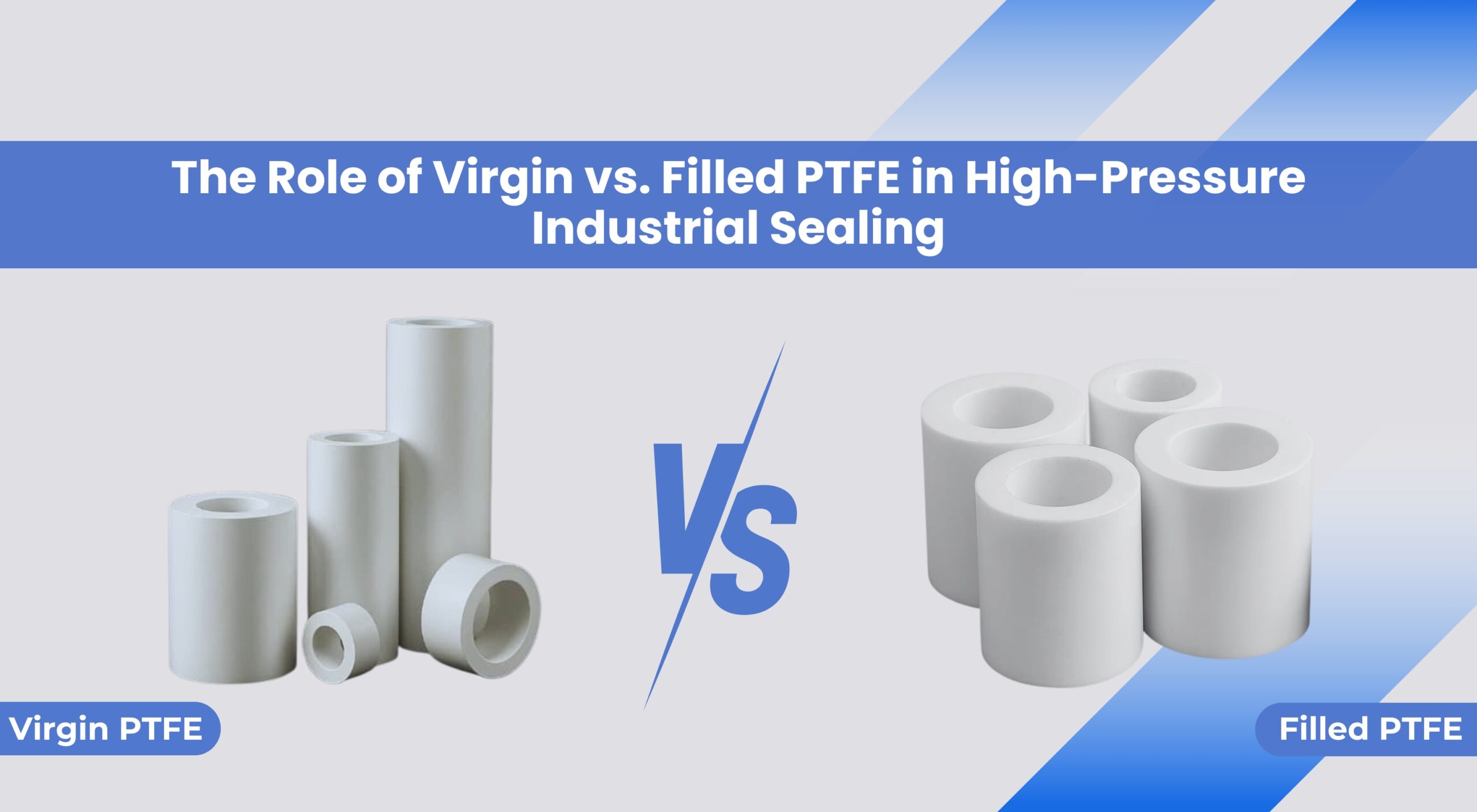
Sealing materials for high-pressure sealing systems must be able to endure harsh environments without degradation in their performance, safety, and longevity. PTFE (Polytetrafluoroethylene) is one of the most reliable materials in this category for chemical resistance, and it has the property of low friction, thermal stability, etc. Nevertheless, it is important to note that the performance of various PTFE materials may differ when subjected to pressure.
The decision to use either virgin PTFE or filled PTFE has a big impact on sealing performance, service life, and equipment reliability, particularly in high-stress environments like those seen in chemical processing, oil and gas, power generation, and pharmaceutical industries.
In this article, the importance of virgin vs. filled PTFE in high-pressure industrial sealing is considered, and the related properties, differences, advantages, limitations of each of these materials, and typical applications are described to facilitate the selection of the proper material by designers and purchasers.
Understanding Virgin PTFE
Virgin PTFE is natural polytetrafluoroethylene that does not include any fillers, additives, or reinforcements. Its purity makes it one of the most chemically inert materials for industrial sealing. Where contamination, chemical interactions, or material breakdown are not an option, virgin PTFE remains the material of choice.
Virgin PTFE seals and gaskets are widely applied in the pharmaceutical, food processing, and specialty chemical industries because they are non-contaminating and meet FDA and other regulatory requirements.
It is important to note that although virgin PTFE is an excellent performer chemically, its mechanical properties are not as impressive, and the effect of mechanical stress in high-pressure environments is more pronounced. Virgin PTFE exhibits creep or cold flow.
Under load, virgin PTFE is known to creep (deform) over time when subjected to a constant load. The deformation may reduce sealing force, which can cause leakage or premature seal failure.
Hence, virgin PTFE is generally recommended for low and medium pressure service, mainly in static sealing applications where little or no motion occurs and low mechanical stresses are involved.
The Mechanical Challenges of Virgin PTFE in High-Pressure Sealing
In high-pressure industrial sealing, materials need to have resistance to compression, dimensional stability, and the ability to endure multiple stress cycles. Since virgin PTFE has a soft molecular structure, its compressive strength is relatively low. With time, a sustained load will cause the material to flow away from the sealing surface, leading to loss of seal integrity.
This restriction renders virgin PTFE not as well-suited for dynamic applications such as rotating shafts, hydraulic pistons, and high-pressure valves. Seal deformation can develop rapidly under such conditions, leading to increased maintenance and operational risk.
These problems gave rise to filled PTFE, which is designed to solve the mechanical weaknesses of pure PTFE.
What Is Filled PTFE?
Filled PTFE is a composite material made by mixing PTFE with various fillers such as glass fiber, carbon, graphite, bronze, and other engineered materials. These fillers improve the mechanical properties of PTFE considerably while maintaining much of its chemical resistance and thermal stability.
The aim is not to lose PTFE’s essential core advantages by adding fillers but rather to enhance them so that they meet the needs of more demanding industrial applications.
Filled PTFE compounds are intended to operate at high loads, high wear conditions, and deflect less than unfilled PTFE under pressure. For these reasons, filled PTFE is considered the workhorse of high-pressure industrial sealing applications.
How Fillers Improve PTFE Performance Under Pressure
- Fillers improve compressive strength and wear resistance of PTFE-based sealing materials.
- Filled PTFE exhibits low creep and reduced cold flow at elevated pressure.
- Improved structure supports long-term seal performance in industrial applications.
- Glass-filled PTFE offers good dimensional stability for high-pressure gaskets and seals.
- Carbon and graphite-filled PTFE provide very low friction and excellent wear resistance in dynamic systems.
- Bronze-filled PTFE offers superior load-bearing capabilities for hydraulic and pneumatic sealing.
- Chemical resistance is slightly reduced but remains suitable for most high-pressure applications.
Bronze-filled PTFE, Glass-filled PTFE, and Carbon-filled PTFE are composites designed to improve strength, wear resistance, and load-handling ability while retaining PTFE’s chemical and thermal stability.
Why PTFE Is Widely Used in Industrial Sealing Applications
- Exceptional resistance to acids, alkalis, solvents, and corrosive media.
- Operates reliably from cryogenic temperatures up to 260°C.
- Low friction reduces heat generation and energy loss.
- Used in gaskets, seals, valve seats, O-rings, and bearings across multiple industries.
- Mechanical performance depends on whether virgin or filled PTFE is used.
Virgin PTFE vs. Filled PTFE in High-Pressure Applications
Virgin PTFE is preferred where chemical purity and regulatory compliance are critical, but its tendency to creep limits its use in high-pressure and dynamic environments. Ultimate Guide to Filled PTFE explains how filled PTFE is engineered for superior mechanical performance.
Filled PTFE resists cold flow, maintains seal integrity under pressure, and performs reliably in both static and dynamic applications. It is widely used in high-pressure valves, pumps, compressors, and hydraulic systems, offering longer service life and reduced maintenance.
| Feature | Virgin PTFE | Filled PTFE |
|---|---|---|
| Purity & Compliance | Highest; FDA/USP Class VI compliant | Depends on filler material |
| Chemical Resistance | Nearly universal | High but filler-dependent |
| Cold Flow | High | Low |
| Pressure Rating | Low to medium | High-pressure capable |
| Wear Resistance | Low | High |
| Typical Applications | Food, pharma, laboratories | Pumps, hydraulics, valves |
Choosing the right PTFE thrust pad depends on your application needs. Learn more in our comparison of Virgin PTFE vs Carbon-Filled PTFE Thrust Pads.
Applications of Virgin and Filled PTFE in Industrial Sealing
- Virgin PTFE is ideal for static gaskets and chemically aggressive environments.
- It is critical where strict purity and safety standards apply.
- Filled PTFE excels under cyclic pressure and mechanical stress.
- Commonly used in hydraulic seals, piston rings, valve seats, and pump components.
- Both materials may be used within the same system for different functions.
Cost Considerations and Long-Term Value
Virgin PTFE has a lower initial cost, but material selection should consider total lifecycle cost.
Filled PTFE often offers lower overall cost of ownership due to longer service life, reduced downtime, and fewer maintenance requirements.
Industry Standards and Quality Requirements
Both virgin and filled PTFE comply with ASTM and ISO standards. Virgin grades are chosen for FDA and USP compliance, while filled grades are selected based on mechanical performance.
Working with experienced manufacturers ensures consistency, traceability, and reliable performance in critical applications.
Conclusion
The choice between virgin and filled PTFE depends on application requirements. Virgin PTFE offers unmatched chemical purity, while filled PTFE provides the strength and stability needed for high-pressure environments.
Understanding pressure, temperature, chemical exposure, and movement helps industries select the right material to improve seal performance, reduce downtime, and protect equipment.