Industrial Excellence
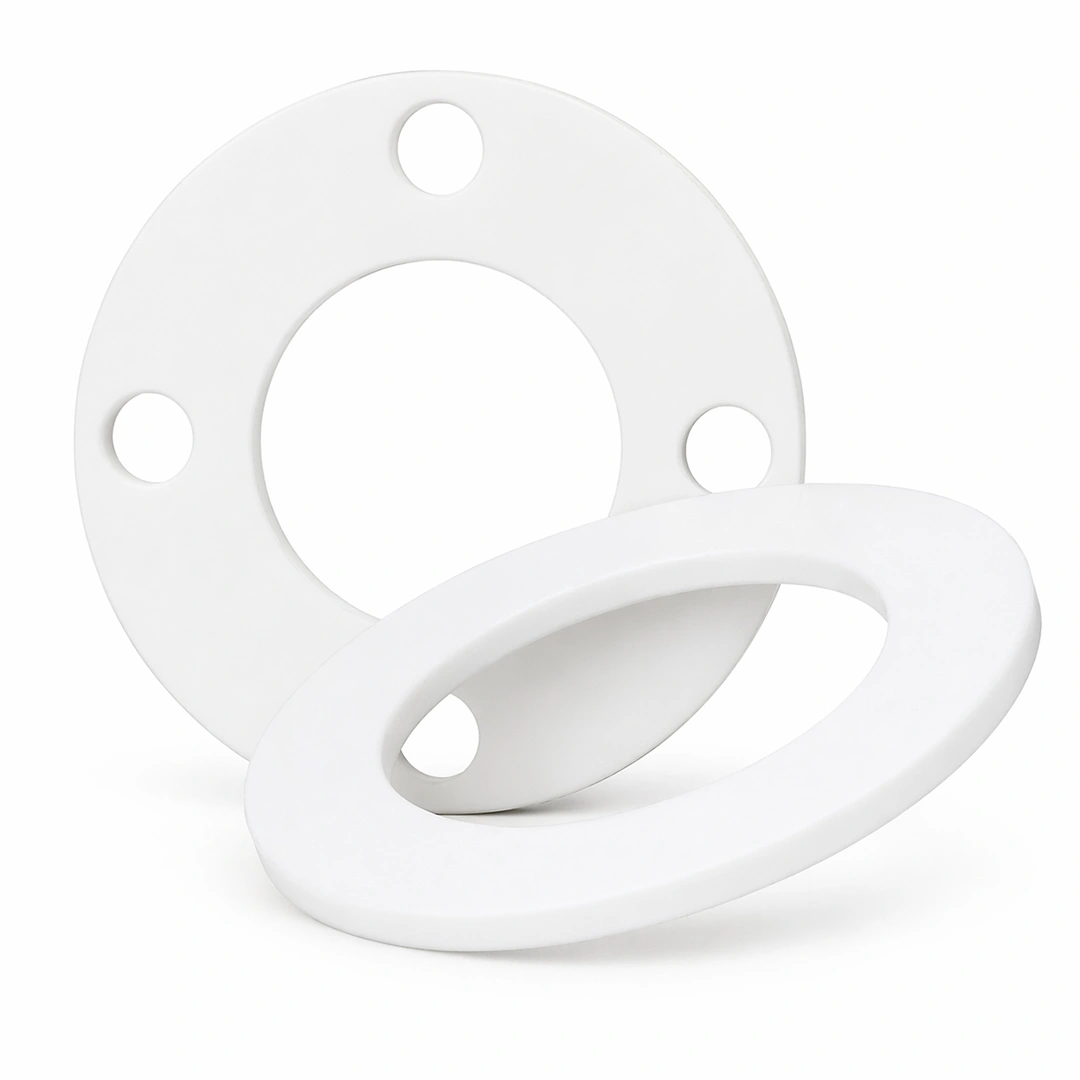
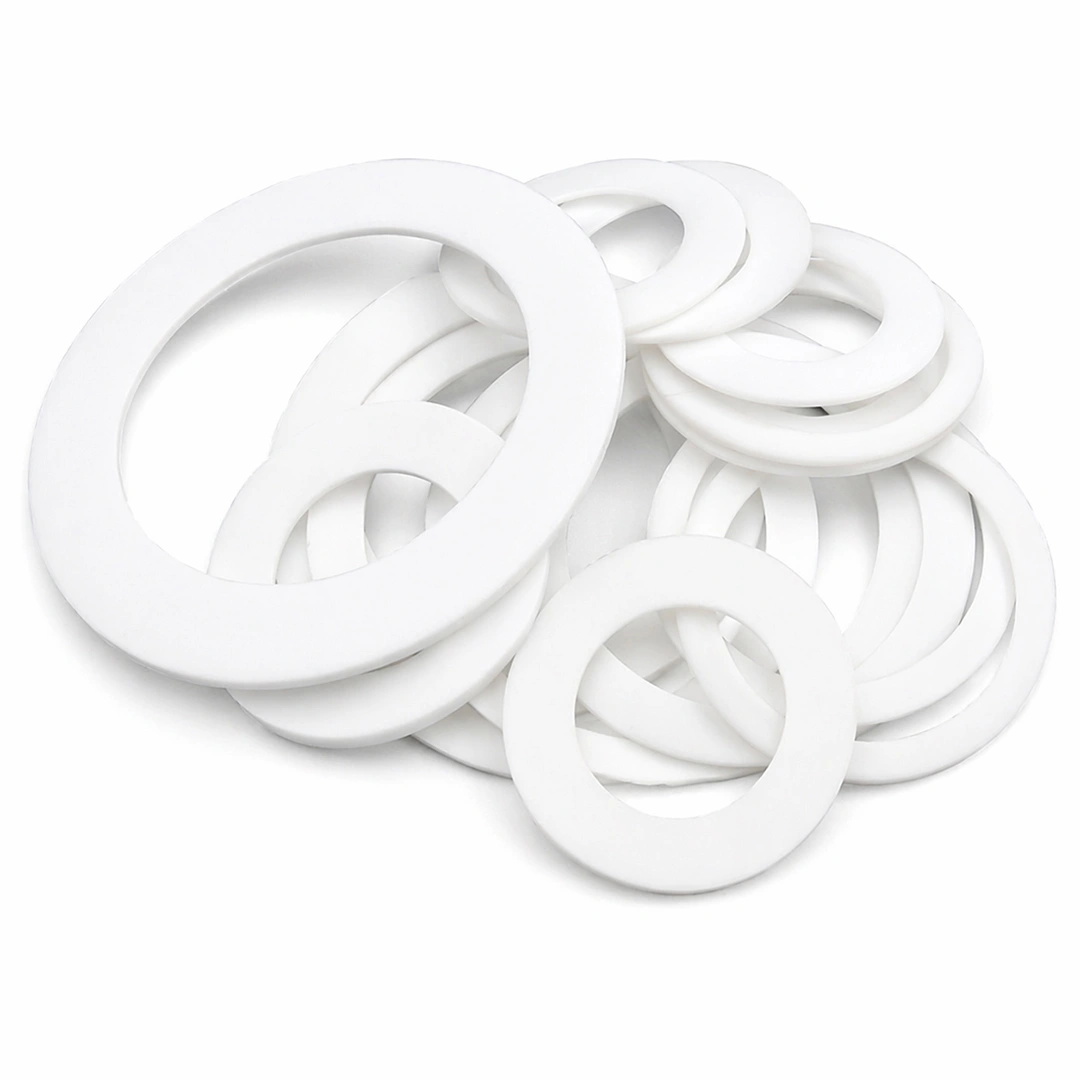
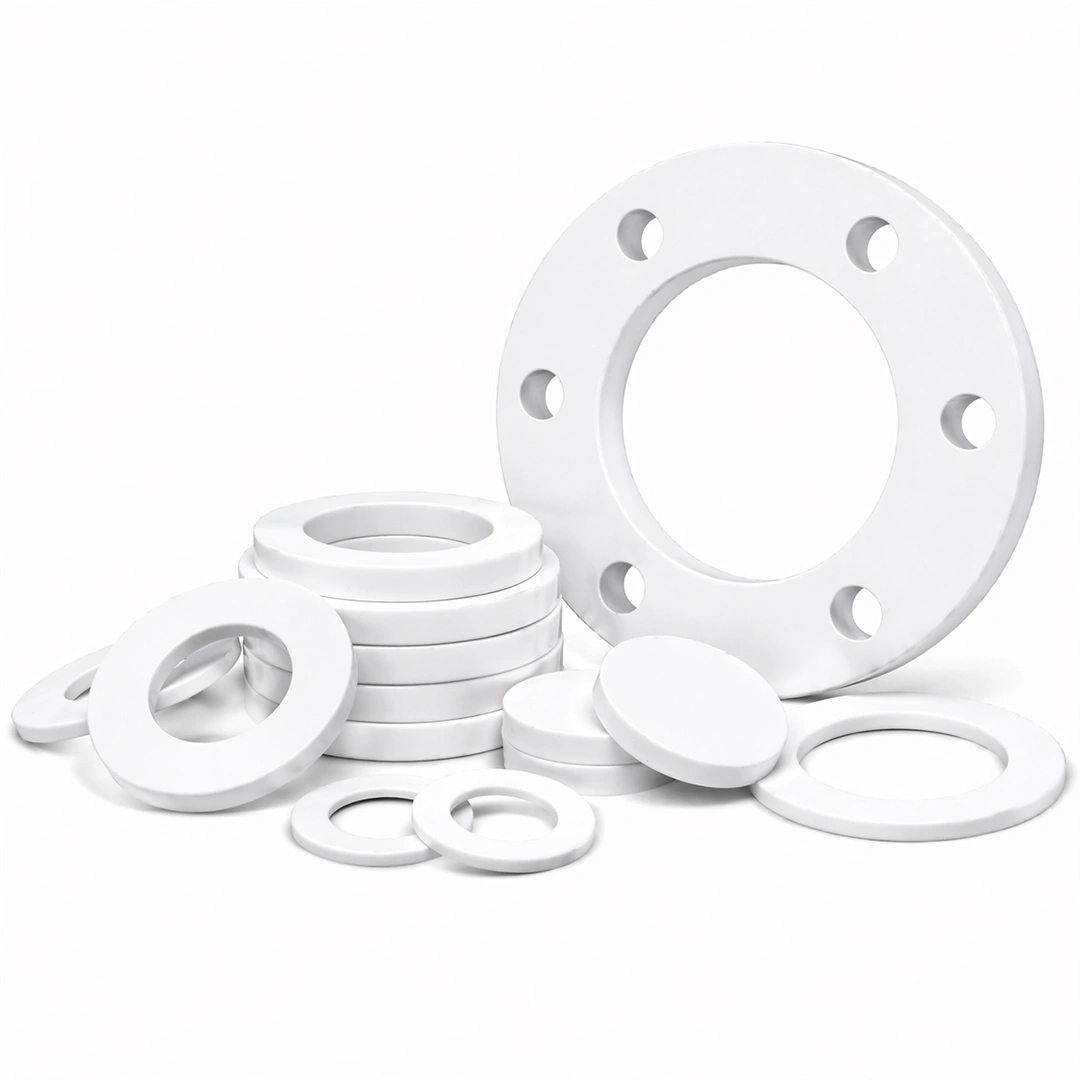
Goa Polymer manufactures PTFE Gaskets and PTFE Flange Gaskets (Polytetrafluoroethylene) from our ISO 9001:2015 certified facility in Maharashtra, India. Available in virgin, glass-filled, carbon-filled, bronze-filled, and expanded PTFE (ePTFE) grades, our gaskets are cut to ASME B16.21, DIN, BS, and custom dimensions for chemical processing, oil & gas, pharmaceutical, food processing, and power generation applications where standard rubber or fibre gaskets fail.


ASME B16.21, DIN 2690/91, BS 4865, IS, Custom
0.5 mm – 12 mm
−200°C to +260°C (ePTFE to −268°C)
Up to PN 160 (ePTFE grade)
Virgin, Glass, Carbon, Bronze-filled, ePTFE
Full-face, Ring, Envelope, Custom profile
A PTFE gasket is a flat sealing element cut from PTFE sheet and placed between two mating surfaces — flange faces, pipe joints, or equipment covers — to prevent leakage of liquids and gases. PTFE is selected when the media is chemically aggressive, when FDA compliance is mandatory, or when operating temperatures exceed the limits of rubber, graphite, or fibre gaskets.
At Goa Polymer, PTFE flange gaskets are cut from certified PTFE sheet stock using CNC waterjet and die-cutting processes. Dimensional accuracy is verified against ASME B16.21, DIN 2690/91, BS 4865, and customer drawings. Each gasket is inspected for thickness uniformity, bore concentricity, and surface condition before packaging. Material test certificates are supplied with bulk shipments.
A PTFE gasket is a flat sealing element cut from PTFE sheet and placed between two mating surfaces — flange faces, pipe joints, or equipment covers — to prevent leakage of liquids and gases. PTFE is selected when the media is chemically aggressive, when FDA compliance is mandatory, or when operating temperatures exceed the limits of rubber, graphite, or fibre gaskets.
At Goa Polymer, PTFE flange gaskets are cut from certified PTFE sheet stock using CNC waterjet and die-cutting processes. Dimensional accuracy is verified against ASME B16.21, DIN 2690/91, BS 4865, and customer drawings. Each gasket is inspected for thickness uniformity, bore concentricity, and surface condition before packaging. Material test certificates are supplied with bulk shipments.

Resists concentrated H₂SO₄, HCl, HNO₃, HF, caustic soda, chlorine, and most organic solvents. The only gasket material that covers virtually the entire industrial chemical spectrum.

Seals reliably from cryogenic liquid nitrogen lines to steam systems and high-temperature chemical reactors. ePTFE grade extends this to –268°C for LNG applications.

Virgin PTFE gaskets comply with FDA 21 CFR 177.1550. Non-toxic, non-leaching, tasteless, and odourless — approved for direct contact with food, beverages, and pharmaceutical intermediates.

Expanded PTFE (ePTFE) gaskets conform to corroded, pitted, or uneven flange surfaces where rigid gaskets fail. Ideal for maintenance-critical applications on aged equipment.

Water absorption below 0.01% — PTFE gaskets perform identically in steam service, immersed applications, and high-humidity environments without swelling or dimensional change.

Dielectric strength of 18–20 kV/mm makes PTFE flange gaskets effective dielectric insulators between dissimilar metals — preventing galvanic corrosion across flanged joints.
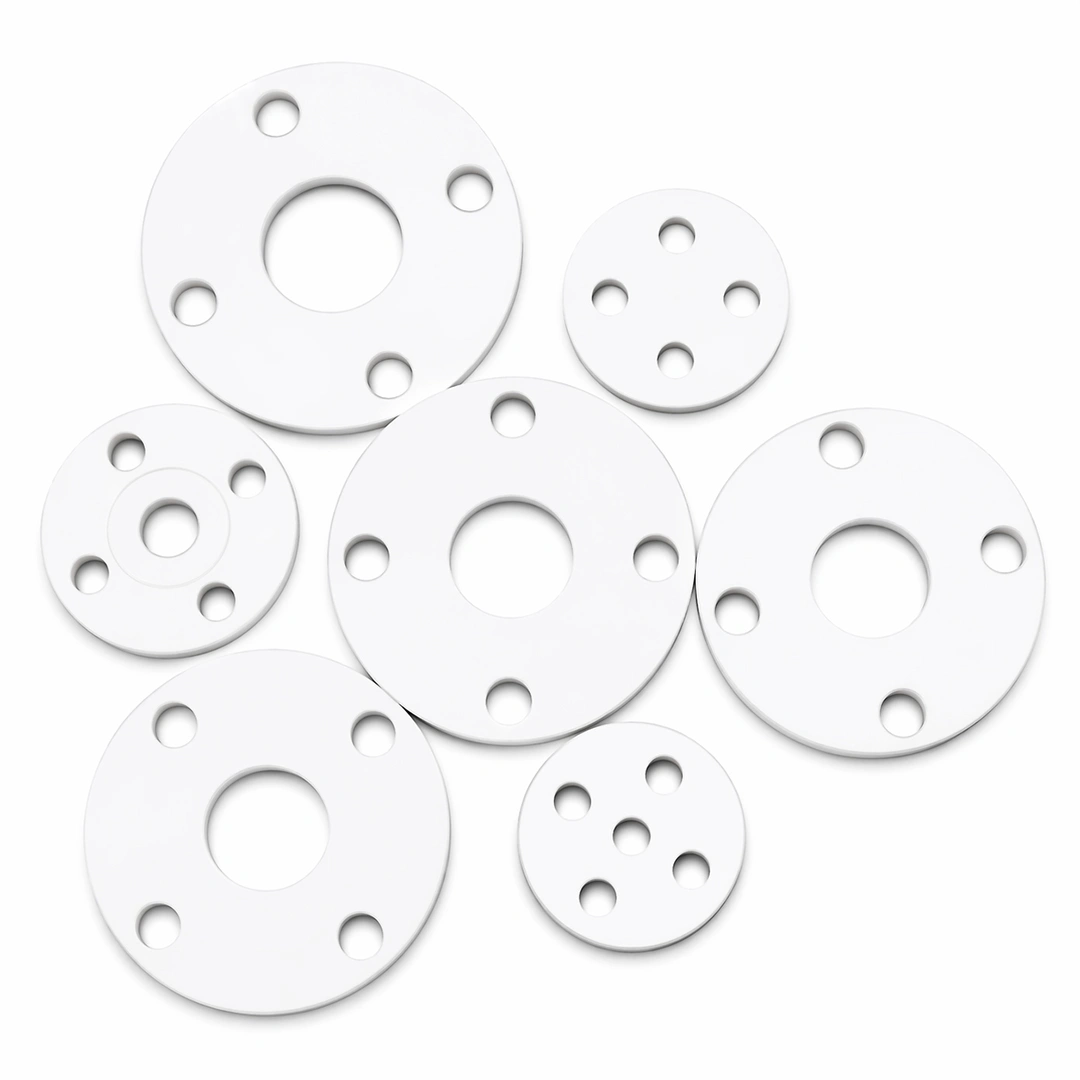
Goa Polymer supplies four standard PTFE gasket configurations, plus fully custom-profiled gaskets cut to any drawing. Select the type that matches your flange face and pressure class.
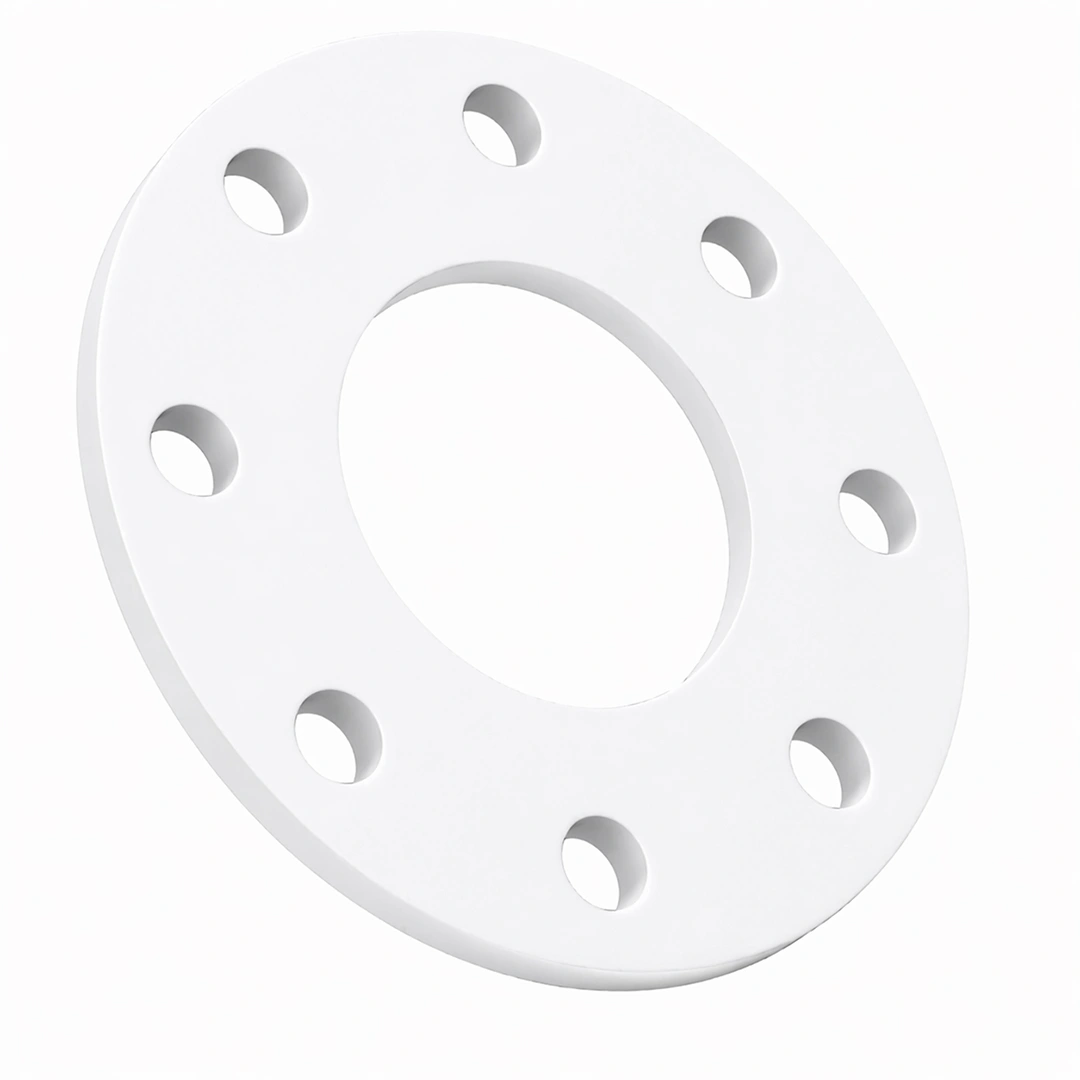
Type FF · Flat-Face Flanges
Covers the entire flange face including all bolt holes. Distributes bolt load uniformly across the full contact area, preventing flange bending on non-metallic or brittle flanges.
Type RF · Raised-Face Flanges
Seats inside the bolt circle on a raised-face flange. Concentrates sealing load on a smaller area, achieving higher seating stress for tighter shut-off at elevated pressure.
PTFE over filler core
A PTFE envelope encases a fibre, elastomer, or spiral wound core. Combines PTFE’s chemical resistance with the mechanical resilience of the inner core — preventing blowout at high pressure.
Soft-cut · Highest conformability
Made from expanded PTFE — a microporous, highly compressible form of PTFE. Seals at very low bolt loads and conforms to damaged or uneven flange surfaces that rigid PTFE cannot seal.
✂️Custom gasket fabrication: Non-circular profiles, manhole covers, equipment nozzle gaskets, heat exchanger bonnet gaskets — any shape cut to your drawing in any PTFE grade. Send your DXF or dimensional sketch via our contact form for a quote.
Selecting the right PTFE grade determines whether your gasket lasts months or years. The table below maps each grade to its pressure rating, temperature limit, and primary use case.
| Grade | Temperature Range | Max Pressure (PN) | Primary Use Case | FDA Compliant |
|---|---|---|---|---|
| Virgin PTFE | –200°C to +260°C | Up to PN 40 | Food, pharmaceutical, ultra-pure chemical lines requiring non-contamination | ● Yes |
| Glass-Filled PTFE | –200°C to +250°C | Up to PN 63 | Chemical plants, steam systems, high-pressure services needing reduced creep | ● No |
| Carbon-Filled PTFE | –200°C to +260°C | Up to PN 100 | Oil & gas, petrochemical, high-load flanges — superior wear and compressive strength | ● No |
| Bronze-Filled PTFE | –180°C to +240°C | Up to PN 40 | Compressors, pumps — high thermal conductivity with mechanical strength | ● No |
| Expanded PTFE (ePTFE) | –268°C to +260°C | Up to PN 160 | Cryogenics, damaged flanges, cleanrooms, vacuum sealing — highest conformability | ● Yes |
DN15 to DN1200
millimetres
mm standard | ±0.05 mm on request
✂️Custom gasket fabrication: Non-circular profiles, manhole covers, equipment nozzle gaskets, heat exchanger bonnet gaskets — any shape cut to your drawing in any PTFE grade. Send your DXF or dimensional sketch via our contact form for a quote.
| Property | Value | Test Standard | Notes |
|---|---|---|---|
| Tensile Strength | 20 – 30 MPa | ASTM D638 | Resistance to pull-out under bolt load |
| Elongation at Break | 150 – 250 % | ASTM D638 | Flexibility for flange conformance |
| Compressive Strength | 10 – 15 MPa | ASTM D695 | Load-bearing without permanent deformation |
| Hardness (Shore D) | 55 – 65 | ASTM D2240 | Surface hardness under bolt compression |
| Density | 2.10 – 2.30 g/cm³ | ASTM D792 | Weight per unit volume |
| Creep Relaxation | Low (higher in filled grades) | – | Glass/carbon-filled grades minimise retorquing |
| Property | Value | Test Standard | Notes |
|---|---|---|---|
| Continuous Service Temperature | –200°C to +260°C | – | ePTFE grade: –268°C to +260°C |
| Short-Term Max Temperature | +300°C | – | Brief excursion without blowout |
| Thermal Conductivity | 0.25 – 0.30 W/m·K | ASTM C177 | Thermal insulator — reduces flange heat loss |
| Property | Value | Test Standard | Notes |
|---|---|---|---|
| Tensile Strength | 20 – 30 MPa | ASTM D638 | Resistance to pull-out under bolt load |
| Elongation at Break | 150 – 250 % | ASTM D638 | Flexibility for flange conformance |
| Compressive Strength | 10 – 15 MPa | ASTM D695 | Load-bearing without permanent deformation |
| Hardness (Shore D) | 55 – 65 | ASTM D2240 | Surface hardness under bolt compression |
| Density | 2.10 – 2.30 g/cm³ | ASTM D792 | Weight per unit volume |
| Creep Relaxation | Low (higher in filled grades) | – | Glass/carbon-filled grades minimise retorquing |
PTFE flange gaskets are specified wherever standard rubber, graphite, or compressed fibre gaskets are unsuitable — because of chemical attack, temperature limits, or purity requirements.

Flanged joints on acid piping, reactor nozzles, storage tank outlets, and scrubber connections. Carbon or glass-filled for high-pressure services.

Pipeline flanges, refinery heat exchangers, separator vessels, and wellhead connections. Carbon-filled PTFE for HPHT services handling H₂S and crude.

FDA-compliant virgin PTFE gaskets for reactor flange connections, sterile transfer piping, and CIP/SIP circuits in GMP environments.

Filling lines, pasteurisation circuits, dairy processing, and brewery piping. Virgin PTFE — non-reactive, no taste or odour transfer, easy to sanitise.

Steam turbine inlet flanges, boiler feedwater connections, and condenser piping. Glass-filled PTFE handles steam service and thermal cycling.

Chlorine and hypochlorite dosing systems, ozone generators, and filter connections — where chlorine and oxidising chemicals attack rubber gaskets rapidly.

ePTFE gaskets rated to –268°C for liquid nitrogen, LNG, and liquid oxygen systems where most polymer gaskets embrittle and fail on cool-down.

Black liquor, white liquor, and bleaching circuit flanges. PTFE resists the extreme alkalinity of pulping chemicals that destroy rubber gaskets within weeks.

Ultra-pure chemical delivery lines, wet bench piping, and etch systems. Virgin PTFE ensures zero ionic contamination to process chemicals.
How does a PTFE flange gasket compare to rubber (EPDM, Neoprene), compressed fibre (CNAF), spiral wound, and graphite gaskets? The table covers the parameters engineers check during gasket selection.
| Parameter | PTFE ✓ | ePTFE | Rubber (EPDM) | CNAF (Fibre) | Graphite |
|---|---|---|---|---|---|
| Chemical resistance | ● Excellent (all acids/bases) | ● Excellent | ● Limited (acids attack) | ● Limited (strong acids) | ● Good (oxidising media bad) |
| Temperature range | –200°C to +260°C | –268°C to +260°C | –40°C to +150°C | –40°C to +200°C | –200°C to +450°C |
| Max pressure (PN) | Up to PN 100 | Up to PN 160 | Up to PN 25 | Up to PN 40 | Up to PN 250 |
| FDA / food safe | ● Yes (virgin) | ● Yes | Grade-dependent | ✕ No | ✕ No |
| Seals on damaged flanges | ● Rigid type — no | ● Yes — highly conformable | ● Partially | ✕ No | ✕ No |
| Creep / retorquing | Low (filled grades) | Near-zero | Low | Moderate | Low |
| Electrical insulation | ● Yes — 18 kV/mm | ● Yes | ● Yes | ✕ No | ✕ No — conductive |
| Moisture absorption | <0.01% — negligible | <0.01% | Significant (swells) | High (fibre swells) | Low |
| Cryogenic suitability | ● Yes — to –200°C | ● Yes — to –268°C | ✕ Embrittles | ✕ No | ● Yes |
A PTFE gasket seals the joint between two flanges, pipe connections, or equipment faces to prevent leakage of liquids and gases. It is chosen over rubber or fibre gaskets when the media is chemically aggressive, when operating temperatures are outside rubber’s range (–40°C to +150°C), or when the application requires FDA compliance — food, beverage, or pharmaceutical service.
Goa Polymer cuts PTFE flange gaskets to ASME B16.21 (Class 150 through Class 2500), DIN 2690 and 2691, BS 4865, and IS standards. Non-standard bore sizes, custom outer diameters, and non-circular profiles are also available — send us your drawing or dimensions for a quote.
A full-face gasket covers the entire flange face including all bolt holes. It is used with flat-face (FF) flanges — common on GRP, cast iron, and PVC pipework — where a ring gasket would cause uneven bolt load distribution and flange bending. A ring (raised-face) gasket seats inside the bolt circle on a raised-face (RF) flange, concentrating sealing stress for higher shut-off integrity. If unsure, share your flange drawing and we will confirm the correct type.
Expanded PTFE (ePTFE) is a microporous, highly compressible form of PTFE. Unlike solid PTFE, it seals at very low bolt loads and conforms to corroded, pitted, or machined flange surfaces where a rigid gasket cannot achieve full contact. Use ePTFE when: (1) your flanges are aged or damaged and cannot be re-faced, (2) the service is cryogenic (down to –268°C for LNG), (3) bolt load is limited by flange rating, or (4) the connection requires zero retorquing after installation.
Yes. Virgin PTFE gaskets comply with FDA 21 CFR 177.1550 and are approved for direct contact with food, beverages, and pharmaceutical intermediates. They are non-toxic, non-leaching, odourless, and tasteless. Expanded PTFE (ePTFE) gaskets are also FDA-compliant. Filled PTFE grades (glass, carbon, bronze) are not recommended for food-contact applications.
Yes. PTFE gaskets seal reliably in steam service up to +260°C. For saturated or superheated steam at higher pressures, glass-filled PTFE is preferred over virgin because it has better creep resistance under the sustained compressive load. For high-pressure steam above PN 40, consult our team to confirm the correct grade and thickness.
There is no strict minimum for standard sizes — we supply single-piece orders for maintenance and prototyping, and large production volumes for OEM and EPC contractors. For custom-cut gaskets, a small setup charge may apply for very small quantities. Contact us with your requirements and we will provide transparent pricing for any volume.
Yes. A material test certificate (MTC) confirming PTFE grade, thickness, key mechanical properties, and traceability to raw material batch is provided with every bulk shipment. Our ISO 9001:2015 quality management system ensures complete documentation from sheet stock to finished gasket. Third-party material testing can be arranged for critical plant applications.
The most common PTFE gasket failure mode is creep relaxation — the gasket slowly deforms under sustained bolt load, reducing seating stress until leakage begins. To prevent this: use the correct bolt torque per ASME PCC-1 guidelines, specify glass-filled or carbon-filled PTFE instead of virgin for high-pressure services, check and retorque bolts after the first thermal cycle, and ensure the flange face is clean and in good condition. If flange faces are damaged, switch to ePTFE which is more tolerant of surface irregularities.

Resists concentrated H₂SO₄, HCl, HNO₃, HF, caustic soda, chlorine, and most organic solvents. The only gasket material that covers virtually the entire industrial chemical spectrum.

Seals reliably from cryogenic liquid nitrogen lines to steam systems and high-temperature chemical reactors. ePTFE grade extends this to –268°C for LNG applications.

Virgin PTFE gaskets comply with FDA 21 CFR 177.1550. Non-toxic, non-leaching, tasteless, and odourless — approved for direct contact with food, beverages, and pharmaceutical intermediates.

Expanded PTFE (ePTFE) gaskets conform to corroded, pitted, or uneven flange surfaces where rigid gaskets fail. Ideal for maintenance-critical applications on aged equipment.

Water absorption below 0.01% — PTFE gaskets perform identically in steam service, immersed applications, and high-humidity environments without swelling or dimensional change.

Dielectric strength of 18–20 kV/mm makes PTFE flange gaskets effective dielectric insulators between dissimilar metals — preventing galvanic corrosion across flanged joints.
ISO 9001:2015
Quality Assurance

Virgin, glass-filled, carbon-filled, bronze-filled, and expanded PTFE — all cut from certified sheet stock in our Maharashtra facility. One supplier, one quality system, faster lead times.

ASME B16.21, DIN 2690/91, BS 4865, IS, and customer drawings. CNC waterjet cutting ensures dimensional accuracy across all bore sizes from DN15 to DN1200.

In-process thickness verification, bore concentricity checks, and surface condition inspection on every gasket. Material test certificates available for every batch.

We supply plant maintenance teams, engineering contractors, valve manufacturers, and distributors across India. Flexible MOQ, volume pricing, and scheduled delivery programmes available.

Not sure which grade or type suits your application? Share your process conditions — temperature, pressure, media, flange class — and our team will recommend the correct gasket before you order.
A PTFE gasket seals the joint between two flanges, pipe connections, or equipment faces to prevent leakage of liquids and gases. It is chosen over rubber or fibre gaskets when the media is chemically aggressive, when operating temperatures are outside rubber’s range (–40°C to +150°C), or when the application requires FDA compliance — food, beverage, or pharmaceutical service.
Goa Polymer cuts PTFE flange gaskets to ASME B16.21 (Class 150 through Class 2500), DIN 2690 and 2691, BS 4865, and IS standards. Non-standard bore sizes, custom outer diameters, and non-circular profiles are also available — send us your drawing or dimensions for a quote.
A full-face gasket covers the entire flange face including all bolt holes. It is used with flat-face (FF) flanges — common on GRP, cast iron, and PVC pipework — where a ring gasket would cause uneven bolt load distribution and flange bending. A ring (raised-face) gasket seats inside the bolt circle on a raised-face (RF) flange, concentrating sealing stress for higher shut-off integrity. If unsure, share your flange drawing and we will confirm the correct type.
Expanded PTFE (ePTFE) is a microporous, highly compressible form of PTFE. Unlike solid PTFE, it seals at very low bolt loads and conforms to corroded, pitted, or machined flange surfaces where a rigid gasket cannot achieve full contact. Use ePTFE when: (1) your flanges are aged or damaged and cannot be re-faced, (2) the service is cryogenic (down to –268°C for LNG), (3) bolt load is limited by flange rating, or (4) the connection requires zero retorquing after installation.
There is no strict minimum for standard sizes — we supply single-piece orders for maintenance and prototyping, and large production volumes for OEM and EPC contractors. For custom-cut gaskets, a small setup charge may apply for very small quantities. Contact us with your requirements and we will provide transparent pricing for any volume.
Get expert consultation and a direct manufacturer quote for your project within 24 hours.
© Copyright 2026 by Goa Polymer